Why Is My Knee Still Swollen 4 Weeks After Surgery? What's Normal, Timeline & Recovery Guide
Four weeks after a total or partial knee replacement, many patients expect their leg to look and feel close to normal. When they look down and see persistent swelling, warmth around the joint, or puffiness that worsens by late afternoon, it is completely natural to wonder: Is something wrong with my new knee?
The short answer is no — swelling at four weeks is entirely normal and expected. In fact, post-surgical knee swelling is a standard physiological response to major bone and soft-tissue reconstruction, and mild-to-moderate fluid retention frequently persists for three to six months (and occasionally up to a full year).
However, understanding what is normal swelling versus what signals a complication is critical for your recovery confidence and peace of mind. In this comprehensive clinical guide, Rehalign's senior chartered physiotherapists explain why swelling persists at one month, the biological healing timeline, practical at-home strategies to reduce fluid retention, and key red flags that require medical review.
Why Is the Knee Still Swollen at 4 Weeks?
To understand why swelling lingers, it helps to appreciate what your body underwent during surgery. During a knee replacement, bone ends are precisely resurfaced, ligaments and capsule tissues are released or re-tensioned, and bone marrow channels are accessed.
At week four, your body is actively progressing through the proliferative and early remodelling phases of tissue repair. Several interconnected factors contribute to persistent swelling at this stage:
1. Increased Vascularity & Microvascular Repair
To rebuild damaged periosteum, tendon insertions, and skin incisions, your cardiovascular system establishes a dense network of new capillaries (angiogenesis). This influx of nutrient-rich blood produces localised warmth and increased resting fluid volume in the joint capsule.
2. Disrupted Lymphatic Channels
The surgical incision unavoidably cuts through superficial lymphatic vessels that normally drain excess interstitial fluid from the lower leg back toward the inguinal lymph nodes. Until these lymphatic micro-channels re-route and recanalise, fluid naturally pools in the knee, calf, and ankle due to gravity.
3. Stepping Up Your Rehabilitation Load
Around week three to four, most patients transition from basic bed exercises to more demanding functional tasks: walking longer distances outdoors, attempting stairs without a stick, and working on higher-resistance knee flexion. This healthy mechanical loading temporarily increases joint synovial fluid production and muscular inflammation.
4. Gravity and Dependent Posture
If you spend more time sitting with your feet on the floor (working, watching television, or dining) or standing in the kitchen, gravity pulls fluid down the leg, causing fluid to collect around the infrapatellar fat pad and suprapatellar pouch.
The Post-Surgery Knee Swelling Timeline
Recovery from knee arthroplasty is a marathon, not a sprint. Here is the clinical progression of what patients typically experience:
| Recovery Milestone | Expected Swelling Level | Primary Focus | | :--- | :--- | :--- | | Weeks 1–2 (Acute Phase) | Severe, taut swelling extending from mid-thigh to toes; bruising present. | Wound closure, DVT prevention, passive knee extension, ice and elevation. | | Weeks 3–6 (Subacute Phase) | Moderate localized swelling around patella; increases after walking or standing. | Restoring 90°–110° flexion, quad activation, gait re-education, lymphatic drainage. | | Weeks 7–12 (Functional Phase) | Mild resting swelling; "puffy" knee after strenuous exercise or long days. | Strength restoration, step-ups, stationary cycling, return to driving. | | Months 4–6 (Remodelling Phase) | Minimal baseline swelling; joint feels slightly larger than unoperated knee. | Endurance, prolonged walking, uneven terrain, functional independence. | | Months 6–12 (Maturation Phase) | Occasional tightness after heavy exertion; fluid fully resolves for 90%+ of patients. | Full return to recreational sports, gardening, and long-distance travel. |
What Triggers a "Swelling Flare-Up" at 4 Weeks?
Many patients notice their knee was improving in week three, only to suddenly swell up again in week four. This "two steps forward, one step back" pattern is usually caused by common, manageable triggers:
- Doing "too much, too soon": Feeling good and walking twice your usual distance or attempting gardening before joint tissues have adapted.
- Inadequate rest intervals: Doing all your physiotherapy exercises in one exhausting 60-minute block rather than breaking them into smaller, 10-minute sessions throughout the day.
- Skipping post-exercise cryotherapy: Forgetting to ice and elevate for 15–20 minutes immediately following exercise or walking.
- Sleeping with a pillow under the knee: While placing a pillow beneath the bent knee feels comfortable, it impedes venous return and can cause a permanent flexion contracture (inability to straighten the leg). Always keep the knee straight with pillows under the calf or heel when elevating.
5 Evidence-Based Strategies to Reduce Knee Swelling at Home
If your four-week post-op knee is puffy, tight, or warm, our mobile physiotherapy team recommends the following evidence-led protocol:
1. High-Elevation Positioning (Above Heart Level)
Simply putting your feet up on a low footstool is not enough. To drain interstitial fluid using gravity, lie flat on a sofa or bed and elevate your leg on two or three pillows so your knee and ankle rest higher than your heart for 20–30 minutes, 3 to 4 times per day.
2. Targeted Cold Therapy (Cryotherapy)
Apply a gel cold pack wrapped in a damp towel for 15–20 minutes at a time. Cold constricts dilated local blood vessels, decreasing fluid leakage into the joint space and dulling nerve conduction for natural pain relief. Allow skin temperature to normalize for at least 45 minutes before reapplying.
3. Active Muscle Pump Drills
Muscle contraction acts as a natural vascular pump. Perform 20 repetitions of:
- Ankle Pumps: Pointing and flexing your toes firmly.
- Static Quad Contractions: Pressing the back of the knee down into the mattress for 5 seconds.
- Glute Squeezes: Tightening the buttocks to stimulate pelvic venous return.
4. Gentle Lymphatic Retrograde Massage
Once your surgical incision is completely closed and dry (no scabs, drainage, or open areas), use light upward strokes with moisturiser or oil from mid-calf toward the groin. This guides stagnant fluid into proximal lymph nodes. Never massage over an unhealed wound or without surgical clearance.
5. Progressive Pacing & Exercise Fractionation
Instead of one long walk that leaves your joint throbbing, divide your activity into 3–4 shorter 10-minute walks interspersed with rest, ice, and elevation.
When Is Swelling a Red Flag? (When to Call Your Doctor)
While generalized swelling is normal, sudden or asymmetrical symptoms can indicate a complication such as a Deep Vein Thrombosis (DVT) or a prosthetic joint infection.
Contact your surgical team, GP, or NHS 111 immediately if you experience:
- Severe, throbbing calf pain or tightness that worsens when flexing the foot upwards (DVT indicator).
- Hard, expanding redness or excessive heat spreading outwards from the incision.
- Yellow, green, or foul-smelling discharge oozing from the surgical scar.
- A body temperature or fever above 38°C (100.4°F) accompanied by chills or rigors.
- Sudden shortness of breath, chest pain, or coughing (Medical emergency: call 999 for suspected pulmonary embolism).
- Sudden inability to bear weight or a feeling that the prosthetic joint has given way or shifted.
How In-Home Physiotherapy Accelerates Post-Op Recovery
Travelling to an outpatient hospital clinic with a swollen, stiff knee can be exhausting and painful. Getting in and out of a car often spikes joint inflammation and delays recovery.
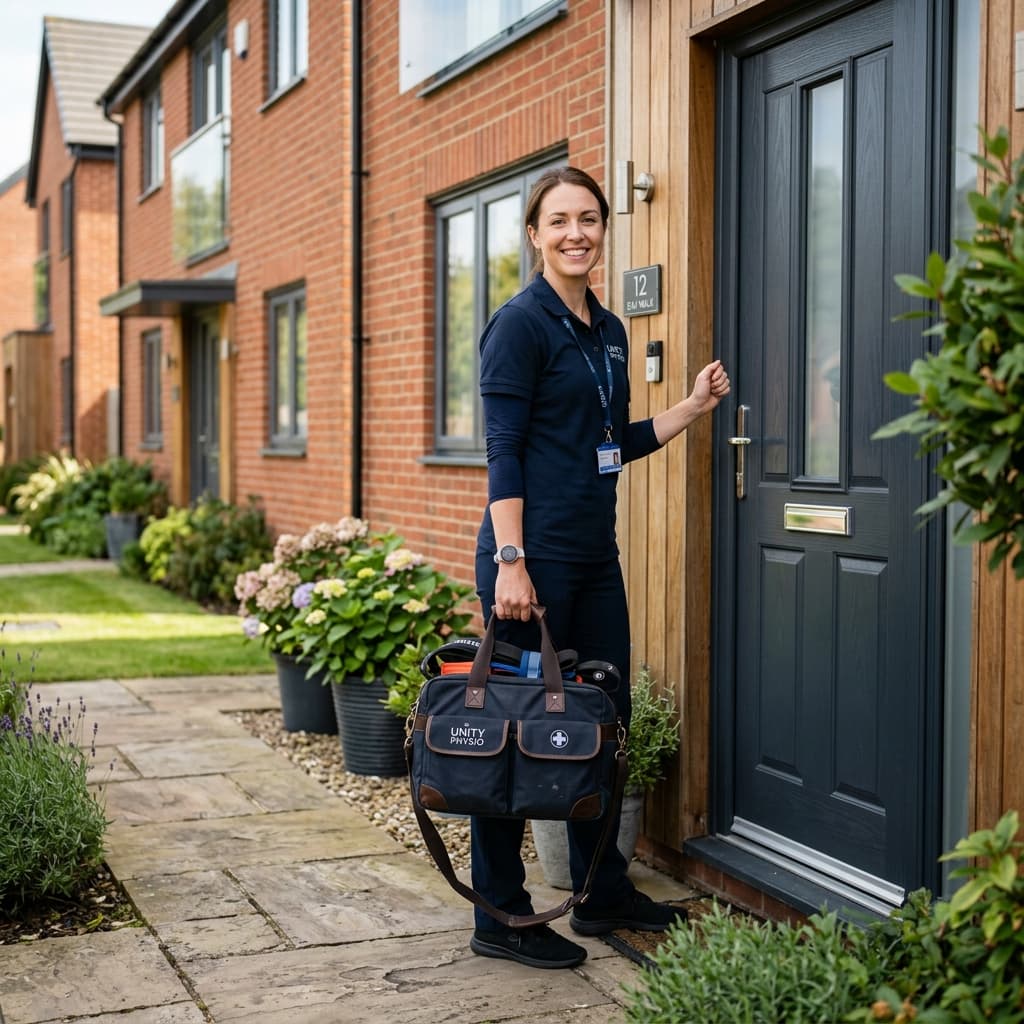
With Rehalign's at-home physiotherapy service, our senior HCPC-registered physiotherapists visit you in the comfort of your own home across Birmingham, Solihull, Walsall, Wolverhampton, Coventry, and the wider West Midlands. We provide:
- Hands-on joint mobilisation and patellar glides to safely free up restricted joint capsules.
- Objective range-of-motion tracking using clinical goniometry.
- Individualised gait re-education so you transition smoothly from two crutches to one stick to independent walking.
- Home environmental safety audits to prevent slips and falls on stairs, rugs, and bathroom surfaces.
Frequently Asked Questions
Yes. Increased local temperature is a normal physiological sign of high cellular metabolic activity and capillary repair. It often persists for 3 to 6 months. However, if the warmth is accompanied by spreading redness, fever, or cloudy discharge, contact your surgical team immediately.
No. Forcing a swollen knee into deep flexion can irritate the joint capsule and cause a reactive inflammatory flare-up that worsens stiffness. Aim for gentle, sustained stretching within comfortable limits (e.g. heel slides to a point of mild stretch, held for 5 seconds) rather than aggressive forcing.
For most patients, noticeable swelling settles significantly by week 12. However, subtle internal tissue thickening and minor puffiness around the scar can remain visible for up to 12 months after surgery before reaching final maturation.
Gentle, paced walking helps muscle pumps move fluid, but excessive walking overloads the joint and causes fluid to accumulate. The key is balance: walk for 10–15 minutes, followed by 20 minutes of elevation and ice. --- *Rehalign provides expert in-home orthopaedic rehabilitation across the West Midlands, including Birmingham, Wolverhampton, Walsall, Dudley, Solihull, and Coventry. [Book an at-home post-surgery assessment](/book) or [contact our clinical team](/contact) to get personalized guidance for your knee recovery.*