Rehalign At-Home Physiotherapy
  • Home
  • About
  • Services
    • Neuro RehabilitationStroke, Parkinson's, MS and brain injury
    • Elderly RehabilitationFalls prevention, balance and strength
    • Orthopaedic & Post-Surgical RehabHip, knee, spine and fracture recovery
    • Musculoskeletal PhysiotherapyBack, neck, joint pain and arthritis
    • All services →
  • Pricing
  • Locations
  • Blog
  • Contact
Book Visit
  1. Home
  2. /
  3. Services
  4. /
  5. Orthopaedic & Post-Surgical Rehab
Orthopaedic & Post-Surgical Rehab

Orthopaedic rehabilitation at home, from the day you leave hospital

You are home, the wound is healing, and the next few weeks shape how well the joint works. We visit you at home, follow your surgeon's instructions to the letter, and rebuild movement, strength and confidence on your own stairs, in your own bed and your own kitchen.

  • No GP referral needed
  • Travel included
  • HCPC-registered physiotherapists
  • £90 first assessment
Book a home assessment£90 · 60 minutes · travel included
Call +44 7450 092175
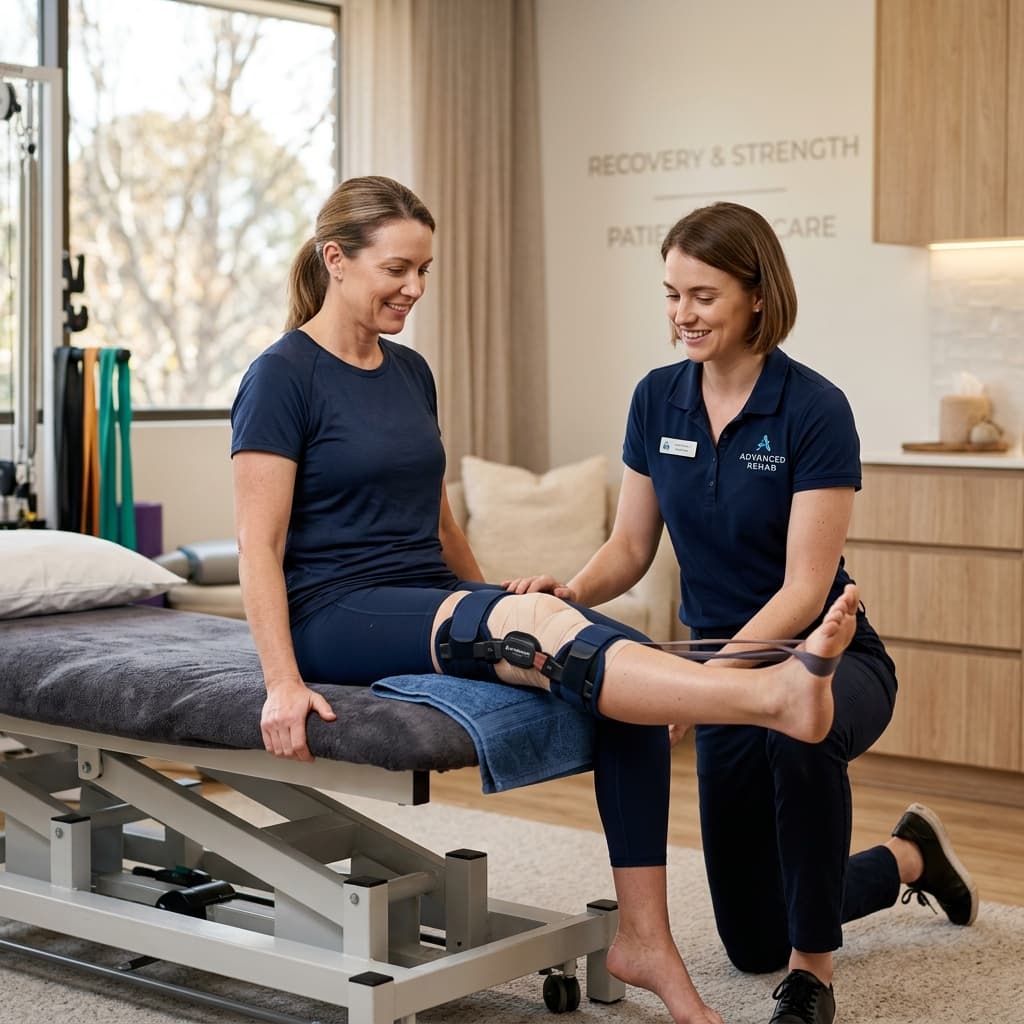
A physiotherapist guides a patient through a knee exercise with a resistance band while the patient sits on a treatment couch

From the hospital door to full strength

  1. Discharge day

    You go home with your surgeon's instructions. We arrange your first visit.

  2. First visit

    We check your wound, swelling, movement, walking aid and how your home works for you.

  3. Early weeks

    Movement returns and gentle strengthening begins, inside your surgeon's limits.

  4. Later weeks

    Stairs, longer walks and everyday tasks get easier as strength builds.

  5. Your goals

    We build towards what you want to do again, from the garden to the golf course.

Every operation and every surgeon is different. Your surgical team's timetable always comes first.

The short answer

What does post-surgical physiotherapy at home involve?

A Rehalign physiotherapist visits after hospital discharge, reads your surgeon's instructions and weight-bearing limits, then guides your recovery: swelling control, safe walking and stairs, regaining movement and progressive strengthening. Sessions are one-to-one, and your surgeon's protocol always takes priority over ours.

Day one at home

Your first days at home, step by step

Coming home from hospital is a lot to take in. This is what we ask of you, and what we do, so that the first week goes smoothly.

  1. 1

    Before you leave hospital

    If you can, tell us your operation, the date and your surgeon before you are discharged. Ask the ward for your discharge summary and any physiotherapy instructions, such as weight-bearing limits or movement precautions, and keep them to hand.

  2. 2

    Your first visit

    We assess your wound, swelling, pain, movement, walking aid, and how you manage transfers, the toilet and the stairs. The first visit lasts 60 minutes and costs £90.

  3. 3

    Your home, made safer

    We look at the route you really use: bed and chair height, stairs, bathroom and trip hazards. A few small changes now prevent setbacks later.

  4. 4

    A plan you can follow

    You leave the first visit with a short exercise programme, a plain list of dos and don’ts, and the date of your next visit.

Recovery roadmaps

What recovery looks like after each type of operation

Choose your operation to see the themes we work on at each stage. Every card uses the same four stages so you can compare them.

  • Knee replacement
  • Hip replacement
  • Spinal surgery (decompression or discectomy)
  • Fracture repair (including hip fracture)
  • Ligament reconstruction (such as ACL)
  • Shoulder surgery (such as rotator cuff repair)

Knee replacement

Regaining bend and straightening, settling swelling and walking confidently on the new knee.

  1. First visits

    Swelling and pain control, gentle bending and straightening exercises, safe transfers and walking with the aid you were given.

  2. Early weeks

    Working towards full straightening and more bend, improving your walking pattern and taking stairs one step at a time.

  3. Middle weeks

    Strengthening the thigh and hip muscles, balance work and building walking distance.

  4. Later weeks

    Moving off walking aids when it is safe, everyday tasks, and returning to activities such as walking, gardening or swimming as your surgeon allows.

How Soon After Knee Replacement Should You Start Home Physiotherapy? →

Hip replacement

Moving safely within your surgeon's precautions, rebuilding hip strength and returning to a normal walking pattern.

  1. First visits

    Safe ways to get in and out of bed, chairs and the toilet, following any movement precautions, and walking with your frame or crutches.

  2. Early weeks

    Progressing walking and stairs, gentle strengthening of the hip and thigh, and settling swelling and bruising.

  3. Middle weeks

    Strengthening the hip muscles, improving balance and a smooth walking pattern, and moving from a frame to sticks when your physiotherapist and surgeon agree.

  4. Later weeks

    Walking further without a limp, getting in and out of the car, and returning to hobbies and exercise as your surgeon allows.

When Can You Stop Using a Walker After a Hip Replacement? →

Spinal surgery (decompression or discectomy)

Protecting the operated area while you get moving again, then building the strength and endurance that support your back. If you have had a fusion, your surgeon’s restrictions will usually be tighter and last longer, and we follow them exactly.

  1. First visits

    Walking little and often, learning to get in and out of bed and to sit and stand comfortably, and keeping to your surgeon's limits on bending, lifting and twisting.

  2. Early weeks

    Gradually increasing walking time, gentle movement and core activation as your surgeon allows, and keeping an eye on any leg symptoms.

  3. Middle weeks

    Progressive strengthening for the trunk and legs, and posture and movement habits for daily life.

  4. Later weeks

    Returning to lifting, household tasks and work in stages, with a long-term plan to keep your back strong.

Fracture repair (including hip fracture)

Restoring movement and strength once the bone is safe to load, while protecting the repair.

  1. First visits

    Learning how much weight you may put through the limb, safe transfers, walking with the right aid, and keeping the joints around the break moving.

  2. Early weeks

    Gentle movement of stiff joints as your surgeon clears it, settling swelling and practising walking.

  3. Middle weeks

    Strengthening and balance work as the bone heals, and relying less on walking aids.

  4. Later weeks

    Rebuilding stamina, confidence and independence, with attention to reducing the risk of another fall.

Hip Fracture Recovery at Home: A Week-by-Week Physiotherapy Guide →

Ligament reconstruction (such as ACL)

A long, staged programme that restores movement first, then strength, then control for sport and work.

  1. First visits

    Settling swelling, regaining full knee straightening and walking normally, with any brace or crutches as directed.

  2. Early weeks

    Waking up the thigh muscles, controlled bending and early balance exercises.

  3. Middle weeks

    Progressive strengthening, single-leg control and, when your surgeon agrees, preparing for light running.

  4. Later weeks

    Sport-specific drills and return-to-activity testing on your surgeon's timetable, which for many people runs over many months.

Shoulder surgery (such as rotator cuff repair)

Protecting the repair, keeping the neck, elbow and hand moving, then gradually restoring shoulder movement and strength.

  1. First visits

    Sling use and positioning as instructed, comfort at night, and keeping the neck, elbow, wrist and hand moving.

  2. Early weeks

    Gentle assisted movement only when your surgeon permits, and posture work.

  3. Middle weeks

    Moving to active movement and light strengthening when the repair allows.

  4. Later weeks

    Rebuilding strength, reach and control for daily tasks, work and hobbies. Full recovery after a rotator cuff repair is often measured in months.

These are typical themes, not a timetable. Every operation, surgeon and patient is different, and your surgical team's instructions always come first. We never progress you faster than they allow.

We follow your surgeon's protocol, not our own

Your surgeon knows exactly what was done in theatre. Our job is to deliver their plan well and to spot early if recovery is not going as expected.

Your surgeon sets the limits
Weight-bearing, movement precautions, bracing and slings are decided by your surgical team. We apply them exactly and adapt every exercise around them.
Questions go to the right person
If a wound, swelling or loss of movement does not look right, we tell you to contact your surgical team or GP, and can write a short note to help.
A clear written plan
After each visit you have a short exercise programme and a plain list of dos and don’ts, so you and your family know what is safe between sessions.
Updates on request
With your consent, we can send a progress summary to your surgeon or GP before a follow-up appointment.

What your visits include

Six things we do at nearly every post-surgical visit, in the order most people need them.

  1. 1

    Swelling and pain management

    Positioning and movement advice, and gentle techniques to settle swelling, bruising and stiffness around the joint.

  2. 2

    Safe movement and transfers

    Getting in and out of bed, a chair, the toilet and the car without putting your repair at risk.

  3. 3

    Walking and stairs, on your own stairs

    Progressing from frame to crutches to sticks, and practising stairs on the stairs you will really use.

  4. 4

    Range of movement

    Graded exercises to restore bend, straightening and reach as your surgeon allows.

  5. 5

    Scar and soft-tissue care

    Once the wound has healed, advice on scar mobility and on tight or tender tissue around it.

  6. 6

    Strength and confidence

    Resistance work, balance and endurance that build up to your own goals, whether that is the supermarket, the garden or the golf course.

When to call your surgical team, your GP, 111 or 999

Most recoveries are uneventful, but some signs need prompt attention. If you are worried, ask. We would always rather you checked. This is general guidance and does not replace advice from your surgical team or GP.

Call 999 or go to A&E

  • Chest pain, sudden breathlessness or coughing up blood, which can be signs of a blood clot in the lung
  • Sudden loss of strength or feeling in an arm or leg, or new loss of bladder or bowel control after spinal surgery
  • Heavy bleeding that does not stop with firm pressure
  • Collapse or sudden severe confusion

Contact your surgical team, GP or NHS 111 the same day

  • A calf that is swollen, hot, red or painful, especially on one side
  • A wound that is redder, hotter, more swollen or more painful, is leaking fluid or pus, or smells
  • A temperature of 38°C or above, or feeling feverish and unwell
  • New or worsening pain that your painkillers do not settle
  • A sudden inability to put weight through the limb, or a joint that looks or feels out of place

More from the NHS: NHS information on joint replacement

Post-surgical rehab at a glance

Who it is for
Adults recovering from joint replacement, spinal surgery, fracture repair, ligament reconstruction or shoulder surgery.
When to start
Usually in the first days after discharge, following your surgeon's instructions. No GP referral is needed.
First visit
A 60-minute assessment, £90.
Follow-up visits
45 minutes, £80 each.
How often
Agreed at your first visit and adjusted to your operation and progress.
Travel
Built into the price of every visit.
Coordination
With your consent, progress notes can go to your surgeon or GP.
Insurance
Receipts carry our HCPC details, so you can claim through your insurer if your policy allows.
Guidance and evidence

What hospitals and trials tell us about recovery at home

We only quote what we can link to. Each card names its source so you can read it yourself.

  • A Swansea Bay University Health Board leaflet tells patients to expect to be walking between six and 24 hours after a total knee replacement, starting with a walking frame and moving on to elbow crutches or sticks.

    Swansea Bay University Health Board: recovering from a total knee replacement (opens in a new tab) ↗
  • A West Hertfordshire Teaching Hospitals leaflet gives a typical hospital stay after knee replacement of about one to three days, depending on fitness, complications and home circumstances, which is why most recovery happens at home.

    West Hertfordshire Teaching Hospitals: physiotherapy after knee replacement (opens in a new tab) ↗
  • NICE says adults with a hip fracture should start rehabilitation at least once a day, no later than the day after surgery, and that support with rehabilitation should continue after discharge.

    NICE quality standard QS16: hip fracture (opens in a new tab) ↗
  • A meta-analysis of randomised trials found no difference in physical function or pain between clinic-based and home-based physiotherapy exercise after knee replacement. The authors noted that the studies were small.

    Artz et al., BMC Musculoskeletal Disorders: effectiveness of physiotherapy exercise following total knee replacement (2015) (opens in a new tab) ↗
Payal Devgan, Senior Chartered Physiotherapist
Lead clinician for this service

Payal Devgan

Senior Chartered Physiotherapist · HCPC PH108630

Payal holds a Bachelor of Physiotherapy and a Level 3 leadership qualification from the University of Birmingham. She leads Rehalign’s home visits for post-surgical rehabilitation.

Every Rehalign physiotherapist is HCPC-registered. Meet the team.

Clear and inclusive

What recovery after surgery costs

Travel is included in every price. For a longer recovery, a session bundle brings the cost per visit down.

ONE-OFF SESSION

Initial Clinical Assessment

£90

  • Full physical & functional assessment
  • Neurological & joint range testing
  • Safety & home environmental screening
  • Personalized rehabilitation pathway design
  • Same-day clinical report & goal planning
Book Initial Assessment
MOST REQUESTED
ONE-OFF SESSION

Standard Treatment Session

£80

  • Hands-on manual therapy & mobilizations
  • Supervised clinical exercise execution
  • Progress tracking & objective measures
  • Continuous home exercise plan adjustments
  • Direct coordination with your GP/consultant
Book Follow-Up Session
SESSION BUNDLE

5-Session Recovery Bundle

£380

£76/session • Save £20

  • 5x Follow-up sessions
  • Fully transferable between specialties
  • Dedicated primary clinician assignment
  • Printed progressive home exercise guides
  • Validity extended for 6 months
Purchase 5-Session Block
BEST VALUE
SESSION BUNDLE

10-Session Realign Block

£720

£72/session • Save £80

  • 10x Follow-up sessions
  • Priority scheduling for home visits
  • Dedicated backup clinician support
  • Advanced progress analysis report
  • Validity extended for 12 months
Purchase 10-Session Block
Questions people ask

Frequently asked questions

How soon after surgery can home physiotherapy start?

+
Usually in the first days after you leave hospital, once your surgeon's team is happy for you to start. You do not need a GP referral. Tell us your operation, the date and your surgeon when you book, and keep your discharge instructions to hand.

Will you follow my surgeon’s instructions?

+
Yes, always. Weight-bearing limits, movement precautions, braces and slings are set by your surgical team, and we apply them exactly. If we think something is not going as expected, we tell you to contact your surgeon or GP rather than changing the plan ourselves.

Is physiotherapy at home as good as going to a clinic after a knee replacement?

+
Trials comparing the two have found no clear difference in function or pain, although the studies were small. The practical advantage of home visits is that we can practise stairs, getting in and out of bed and your own routines where you will actually do them, without a car journey that hurts.

How many sessions will I need after a hip or knee replacement?

+
It depends on the operation, your starting fitness and your goals. We give you an honest estimate at the end of your first visit and review it as you progress. We would rather you finish early than book sessions you do not need.

What should I have ready for the first visit?

+
Your discharge summary and any physiotherapy instructions, a list of your medicines, your walking aid, and loose comfortable clothing. A clear walkway from the door to your chair, bed and bathroom helps us see how you really move around.

Can you treat me after spinal surgery or a fracture, not just a joint replacement?

+
Yes. We support recovery after spinal decompression and discectomy, fracture repair, ligament reconstruction and shoulder surgery as well as hip and knee replacement. Fusions and complex repairs have stricter rules, and we follow your surgeon's protocol for each.

What if my wound looks red or my leg swells?

+
Some swelling and bruising is normal after surgery, but a hot, red or leaking wound, a fever, or a painful, swollen calf need same-day advice from your surgical team, your GP or NHS 111. Chest pain or sudden breathlessness needs 999. Our red-flag panel above lists what to look for.

How much does post-surgical physiotherapy cost?

+
Your 60-minute assessment costs £90 and each 45-minute follow-up is £80. Travel is included and no GP referral is needed. If you expect a longer recovery, a session bundle lowers the cost per visit.

Guides for recovery after surgery

Plain-English articles from our clinicians on the questions patients ask most after an operation.

  • How Soon After Knee Replacement Should You Start Home Physiotherapy?

    Physio starts in hospital within about a day of knee replacement. Learn what happens next, when home physiotherapy helps and what to do in week one.

  • At-Home vs Clinic Physiotherapy After Knee Replacement

    Home vs clinic physiotherapy after a knee replacement: what the research actually shows about outcomes, and how to decide what's right for your recovery.

  • Hip Fracture Recovery at Home: A Week-by-Week Physiotherapy Guide

    Home from hospital after a broken hip? A physiotherapist's week-by-week guide to hip fracture recovery at home: walking, stairs, exercises and red flags.

  • 5 Signs You Need Birmingham Post-Surgery Rehab at Home

    Persistent swelling, stalled mobility, or a long wait for NHS follow-up? 5 signs it's time for post-surgery physiotherapy at home in Birmingham.

  • Managing Scar Tissue Pain After Orthopaedic Surgery

    Scar tissue pain and tightness after orthopaedic surgery is common and usually manageable. When it's safe to start scar therapy, what helps, and warning signs to watch for.

  • Driving After a Hip or Knee Replacement: When Is It Safe?

    General timeframes for driving after joint replacement surgery, what actually determines readiness, and the questions worth asking before you get back behind the wheel.

Hip and knee replacement rehabilitation →Browse all guides →

Post-surgical physiotherapy across the West Midlands

We visit patients recovering at home in all of these towns, and in the postcodes around them.

  • Wolverhampton
  • Walsall
  • Cannock
  • Telford
  • Willenhall
  • Birmingham
  • Coventry
  • Smethwick

Not sure we reach you? Check your postcode on the locations page.

Plan your first visit before you leave hospital

Book ahead and tell us your operation, your surgeon and your discharge date. We will confirm the earliest first visit we can offer once you are home.

Book a home assessment£90 · 60 minutes · travel included
Call +44 7450 092175

Check postcode coverage · See full pricing

Rehalign Footer Logo

Rehalign provides elite in-home physiotherapy across the West Midlands, combining clinical excellence with flexible schedules to support your rehabilitation.

Registered Private Limited Company: 16649377
Incorporated on 14 August 2025

Areas Covered

  • Walsall
  • Wolverhampton
  • Birmingham
  • Solihull
  • Coventry
  • Dudley
  • All 15 Towns →

Specialities

  • Neuro Rehabilitation
  • Elderly Rehabilitation
  • Post-Surgical Rehab
  • Musculoskeletal Physio
  • Stroke Rehabilitation
  • Hip & Knee Replacement
  • Falls Prevention
  • Insurance & Billing
  • FAQ — Common Questions

Stay Aligned

Join our newsletter for monthly clinical mobility guides and exercises.

Contact Clinical Desk

+44 7450 092175 / +44 7574 020868
contact@rehalign.com
West Midlands, UK
Find us on Google Maps →

© 2026 Rehalign Private Limited. All Rights Reserved. Fully insured and registered with HCPC & CSP.

Privacy PolicyTerms of ServiceCancellation Policy