Rehalign At-Home Physiotherapy
  • Home
  • About
  • Services
    • Neuro RehabilitationStroke, Parkinson's, MS and brain injury
    • Elderly RehabilitationFalls prevention, balance and strength
    • Orthopaedic & Post-Surgical RehabHip, knee, spine and fracture recovery
    • Musculoskeletal PhysiotherapyBack, neck, joint pain and arthritis
    • All services →
  • Pricing
  • Locations
  • Blog
  • Contact
Book Visit
  1. Home
  2. /
  3. Services
  4. /
  5. Neuro Rehabilitation at Home
Neuro Rehabilitation at Home

Neurological rehabilitation at home, built around what you want to do again

Recovering from a stroke, or living well with Parkinson's, MS or a brain injury, depends on practising the things that matter, over and over, in the places where they matter. Our physiotherapists bring specialist neurological rehabilitation into your home and teach your family how to help between visits.

  • No GP referral needed
  • Travel included
  • HCPC-registered physiotherapists
  • £90 first assessment
Book a home assessment£90 · 60 minutes · travel included
Call +44 7450 092175
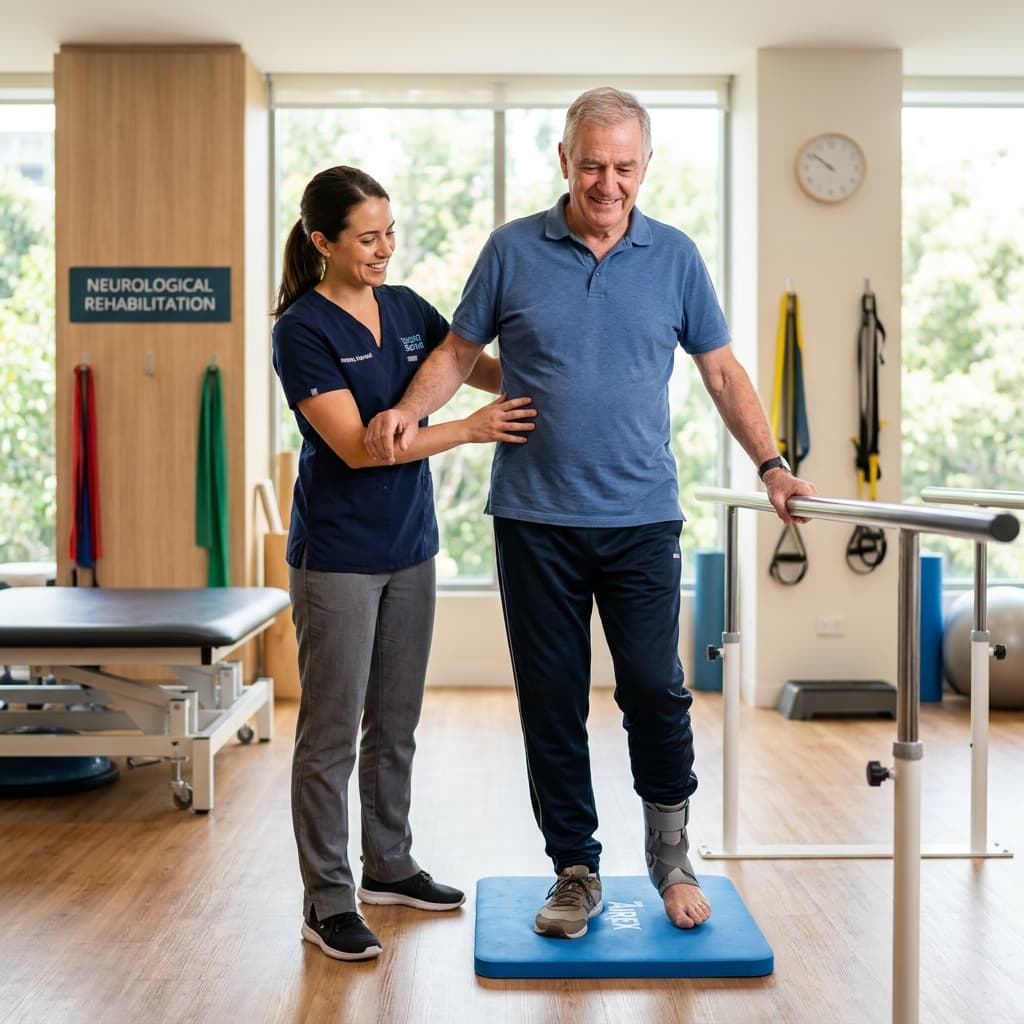
A physiotherapist supports a man standing on a balance pad while he holds a rail
Balance and weight-shifting practice, with hands-on support.

Jump to

  • Stroke
  • Parkinson's disease
  • Multiple sclerosis
  • Brain injury and other conditions
  • Stages of recovery
  • Carers and family

The short answer

What does neurological physiotherapy at home involve?

A neurological physiotherapist visits you at home to assess movement, balance, strength and muscle tone, then agrees goals with you and coaches repeated, task-specific practice of walking, transfers and arm use. Family and carers learn how to support practice between visits, so recovery continues beyond the hour we are there.

Conditions

Four kinds of neurological recovery, four different plans

The principles are shared, but what we practise, and how, depends on the condition. Find yours below.

01

Stroke

A stroke can weaken one side of the body, change feeling, and affect balance, walking and arm use. Fatigue is common. Recovery is fastest early on, but people can keep improving well beyond the first few months with regular, targeted practice.

Stroke rehabilitation at home: the full guide →

What we work on at home

  • Getting in and out of bed, chairs and the toilet safely
  • Walking practice, including on your own stairs and uneven ground outside
  • Arm and hand use for dressing, eating and washing
  • Managing stiffness and muscle tone, and protecting a weak shoulder
  • Pacing the day, because fatigue is common

02

Parkinson's disease

Parkinson's can make movement slower and smaller, and cause stiffness, tremor, freezing and balance problems. Turning and getting up from a chair become harder. Exercise and physiotherapy are part of managing it, and the right cues can make daily movement easier.

Physiotherapy for Parkinson's Disease: Managing Tremors, Freezing, and Mobility at Home →

What we work on at home

  • Big, deliberate movement practice to counter small, slow movement
  • Cueing strategies for freezing and for starting to walk
  • Turning, getting up from chairs and rolling in bed
  • Balance and strength training to reduce the risk of falls
  • Planning exercise around the times your medication works best

03

Multiple sclerosis

MS is unpredictable. Weakness, fatigue, balance problems and stiffness can change from week to week, or flare. Physiotherapy helps people stay strong, mobile and active, and adapts as symptoms change.

What we work on at home

  • Strength and endurance work set at a level that avoids over-tiring
  • Balance and walking practice, with advice on aids if they help
  • Stretching and positioning for stiffness and spasms
  • Fatigue and activity planning
  • A plan for flare-ups, and for returning to exercise after one

04

Brain injury and other neurological conditions

After a traumatic or acquired brain injury, a spinal cord injury or a condition affecting the nerves, movement, balance and coordination can change. We assess what is limiting function and set practical goals together.

What we work on at home

  • Balance, coordination and walking re-education
  • Strengthening weakened muscles and managing muscle tone
  • Practising everyday tasks in the places they happen
  • Safety around the home and during transfers
  • Clear goals and outcome measures, so progress is visible
Recovery stages

How rehabilitation changes as recovery moves on

The goals shift over time. This is how we usually think about it after a stroke or brain injury, though everyone’s recovery is different.

  1. 1Early weeks

    Safe, then moving

    In the first weeks the focus is safety and getting moving: safe transfers, sitting and standing balance, and early walking and arm practice, with plenty of rest between.

    Typical goals

    • Transfer safely
    • Sit and stand with good balance
    • Take first steps with the right support
  2. 2Months in

    Building independence

    Practice becomes more demanding and more varied: longer walks, stairs, outdoor surfaces, arm and hand tasks, and looking after yourself. This is where practice with family between visits matters most.

    Typical goals

    • Walk further and on varied ground
    • Manage stairs and kerbs
    • Use the affected arm in daily tasks
  3. 3Long term

    Keeping and extending gains

    Recovery does not stop at a set date. We help you keep strength and fitness, take on new goals, and adjust the plan as needs change, with fewer visits as your own programme takes over.

    Typical goals

    • Keep a regular exercise habit
    • Reduce the risk of falls
    • Return to hobbies, social life or work where possible

These stages describe recovery after a sudden event such as a stroke or brain injury. Parkinson’s and MS follow a different course, so for them we review the plan regularly and adjust it as symptoms change.

How neurological physiotherapy differs from general physiotherapy

Both are delivered by physiotherapists, but the questions asked and the methods used are different.

General physiotherapy compared with neurological physiotherapy
TopicGeneral physiotherapyNeurological physiotherapy
Starting pointUsually a joint, muscle or injury problem.Movement problems caused by the brain, spinal cord or nerves, so we assess control, muscle tone, balance and sensation as well as strength and range.
Main methodTreat the painful or stiff area, then strengthen.Repeated, task-specific practice of real activities such as standing up, walking and reaching, so the nervous system relearns them.
Hands-on supportMostly independent exercise.Guidance and positioning from the physiotherapist, reduced as you take over.
Muscle toneRarely a focus.Managed through stretching, positioning and activity, and flagged to your doctor when medication might help.
FatigueConsidered when planning exercise.A main factor: sessions are paced, and families are shown how to plan the day.
Family and carersOptional.Central: carers learn safe handling and how to help with practice.

What neurological rehabilitation with Rehalign includes

Six parts of every plan, whatever the diagnosis.

Specialist neurological assessment

A 60-minute first visit covering movement control, muscle tone, balance, walking, strength, sensation, fatigue and how you manage at home.

A plan built on your goals

We agree goals that matter to you, such as walking to the shops or holding a cup, and measure progress against them.

Task-specific practice at home

Standing up from your own chair, climbing your own stairs, using your own kitchen. Practice helps most when it looks like real life.

Walking, balance and falls

Walking re-education, balance work, and advice on walking aids, splints and footwear.

Arm and hand recovery

Repetitive, graded practice of reach, grasp and release, with advice on protecting a weak shoulder.

Home set-up and equipment

Practical suggestions for bed, chair, bathroom and stairs, and signposting to occupational therapy for fitted equipment.

For carers and family

Recovery continues between visits, so we teach the people who are there

We are with you for under an hour per visit. The hours in between are where recovery is built, and family and carers are often the ones who help.

Carers are welcome at every visit. With the patient’s consent, we can write to the GP or consultant.

  • Safe handling

    How to help someone stand, transfer or walk without hurting either of you.

  • Practice partners

    A short list of exercises, with pictures, that you can do together between visits.

  • What to watch for

    Early signs of problems such as a painful shoulder, new swelling or a change in balance, and who to tell.

  • Looking after you

    Carers get tired too. We help you pace your own day and know when to ask for more support.

Neuro rehabilitation at a glance

Who it is for
Adults living with stroke, Parkinson's disease, multiple sclerosis, brain injury, spinal cord injury or other neurological conditions.
When to start
At any stage: shortly after discharge, months or years after a stroke, or after a diagnosis of Parkinson's or MS.
First visit
A 60-minute assessment, £90.
Follow-up visits
45 minutes, £80 each.
Carers and family
Welcome at every visit and taught how to help between sessions.
Referral
None needed. We can write to your GP or neurologist with your consent.
Travel
Included in every visit, with no mileage surcharge.
Guidance and evidence

What national guidance says about neurological rehabilitation

NICE and Cochrane are the sources we trust most. Each card links to the original.

  • NICE’s stroke rehabilitation guideline recommends early supported discharge for people who can move from bed to chair, with or without help, and who have a safe home to go to, with therapy continuing at the same intensity as in hospital.

    NICE guideline NG236: stroke rehabilitation in adults (2023) (opens in a new tab) ↗
  • NICE recommends Parkinson's-specific physiotherapy for people who have balance or motor function problems.

    NICE guideline NG71: Parkinson's disease in adults (opens in a new tab) ↗
  • NICE’s multiple sclerosis quality standard says services should provide supervised exercise programmes for adults with MS who may benefit because of problems with mobility or fatigue.

    NICE quality standard QS108: multiple sclerosis in adults (opens in a new tab) ↗
  • A Cochrane review found that, compared with no physiotherapy, physiotherapy gave small improvements in walking speed and balance in Parkinson's disease. The authors cautioned that the trials were of variable quality.

    Tomlinson et al., Cochrane review: physiotherapy versus placebo or no intervention in Parkinson's disease (2013) (opens in a new tab) ↗
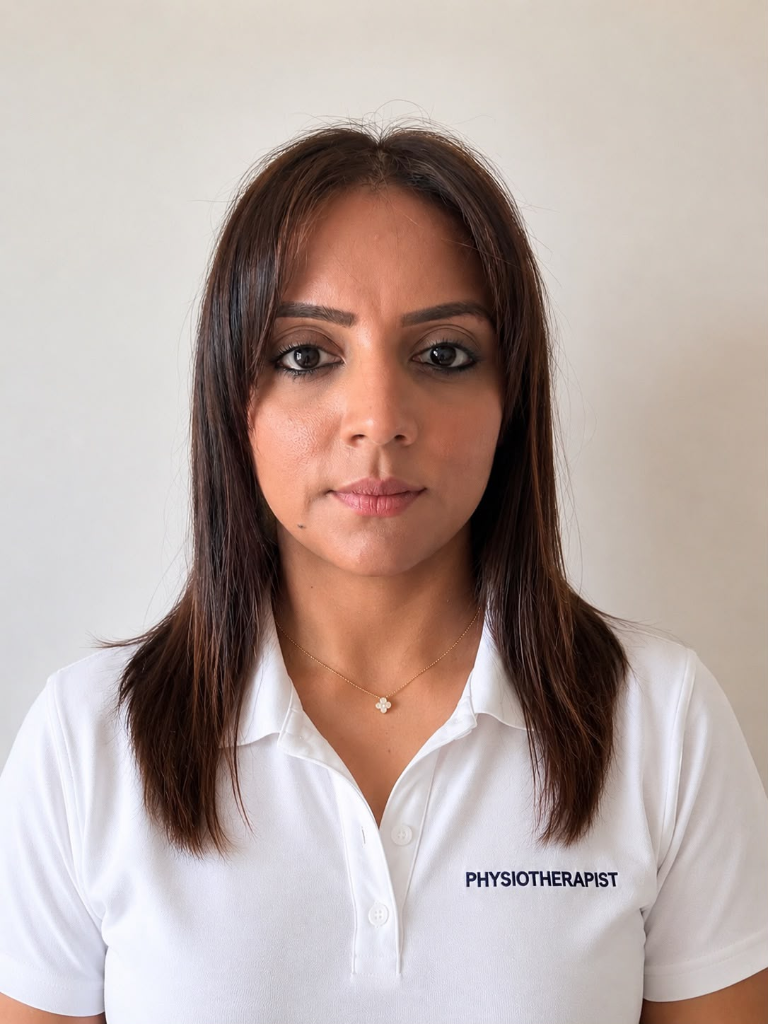
Manisha Dogra, Senior Neurological Physiotherapist
Lead clinician for this service

Manisha Dogra

Senior Neurological Physiotherapist · HCPC PH106181

Manisha holds a BSc in Physiotherapy, is a member of ACPIN and has 15 years of post-graduate experience in neurological and musculoskeletal rehabilitation.

Every Rehalign physiotherapist is HCPC-registered. Meet the team.

Clear and inclusive

What neurological rehabilitation costs

Travel is included in every price. Neurological recovery usually takes more than a few visits, so bundles can bring the cost per session down.

ONE-OFF SESSION

Initial Clinical Assessment

£90

  • Full physical & functional assessment
  • Neurological & joint range testing
  • Safety & home environmental screening
  • Personalized rehabilitation pathway design
  • Same-day clinical report & goal planning
Book Initial Assessment
MOST REQUESTED
ONE-OFF SESSION

Standard Treatment Session

£80

  • Hands-on manual therapy & mobilizations
  • Supervised clinical exercise execution
  • Progress tracking & objective measures
  • Continuous home exercise plan adjustments
  • Direct coordination with your GP/consultant
Book Follow-Up Session
SESSION BUNDLE

5-Session Recovery Bundle

£380

£76/session • Save £20

  • 5x Follow-up sessions
  • Fully transferable between specialties
  • Dedicated primary clinician assignment
  • Printed progressive home exercise guides
  • Validity extended for 6 months
Purchase 5-Session Block
BEST VALUE
SESSION BUNDLE

10-Session Realign Block

£720

£72/session • Save £80

  • 10x Follow-up sessions
  • Priority scheduling for home visits
  • Dedicated backup clinician support
  • Advanced progress analysis report
  • Validity extended for 12 months
Purchase 10-Session Block

Guides for stroke, Parkinson’s and neurological recovery

Practical articles from our clinicians, written for patients and the people helping them.

  • Stroke Recovery at Home: Neurological Physiotherapy in the West Midlands

    Discover how expert neurological physiotherapy in Birmingham and the West Midlands helps stroke survivors achieve faster, more functional recovery at home.

  • How Long Does Neuroplasticity Take to Kick In After a Stroke?

    A physiotherapist's guide to the real neuroplasticity timeline after stroke — what happens in the first days, weeks, and months, and why rehab intensity and timing both matter.

  • Physiotherapy for Parkinson's Disease: Managing Tremors, Freezing, and Mobility at Home

    Discover how home-based neurological physiotherapy for Parkinson's disease uses amplitude training, cueing strategies, and balance exercises to manage freezing, tremors, and mobility.

  • Understanding and Managing Spasticity After a Stroke: A Home Physiotherapy Guide

    What spasticity actually is, why it develops after stroke, the home management approaches that help most, and when increased muscle tone needs further assessment.

  • Can Physiotherapy Help Regain Hand Function After a Stroke?

    Yes — physiotherapy can help regain hand function after a stroke, at any stage of recovery. How task-specific training, CIMT and home practice work.

  • How to Safely Help a Stroke Survivor With Home Exercises

    Family guide to helping with stroke exercises at home: where to stand, how to protect the weak arm, how to encourage effort and when to stop.

Stroke rehabilitation at home →Browse all guides →
Questions people ask

Frequently asked questions

How is neurological physiotherapy different from ordinary physiotherapy?

+
Neurological physiotherapy deals with movement problems that start in the brain, spinal cord or nerves. We assess muscle tone, control, balance and sensation, and rely on repeated, task-specific practice rather than treating a single sore joint. Family and carers are usually part of the plan.

Can physiotherapy help months or years after a stroke?

+
Yes. Recovery is fastest early on, but people can keep improving with regular, targeted practice long after the first few months. The goals change from regaining basic movement to building fitness, confidence and independence.

When can rehabilitation start at home after a stroke?

+
NICE recommends early supported discharge for people who can move from bed to chair, with or without help, and who have a safe place to go home to, with therapy continuing at a similar intensity to hospital. Private physiotherapy can sit alongside NHS community services, so tell us what you already receive and we will plan around it.

Does physiotherapy help Parkinson's disease?

+
Yes. NICE recommends Parkinson's-specific physiotherapy for people with balance or motor function problems. We work on the size of movement, turning, freezing, strength and balance, and teach cues you can use every day.

Is exercise safe with multiple sclerosis?

+
Exercise is a recognised part of MS care, and NICE’s quality standard supports supervised exercise for adults who have mobility or fatigue problems. We set the programme at a level that avoids over-tiring and adjust it during flare-ups. Tell us how your symptoms vary and we will plan around it.

Can family members take part in sessions?

+
Yes, and we encourage it. We show carers how to help someone move safely, which exercises to practise together, and what to watch for between visits. With your consent we can also write to your GP or consultant.

What should I prepare before my first neurological assessment?

+
A list of your diagnoses and medicines, any recent letters or scan reports, any walking aids or splints you use, and, if possible, a family member or carer. We bring the equipment we need.

How much does neurological physiotherapy cost?

+
The first visit is a 60-minute assessment at £90, and each 45-minute follow-up costs £80. Travel is part of the price, you need no GP referral, and session bundles reduce the cost per visit for longer programmes.
Neurological physiotherapy across the West Midlands

Our neuro team visits patients at home in these towns, and in the postcodes around them.

  • Birmingham
  • Solihull
  • Coventry
  • Walsall
  • Wolverhampton
  • Dudley
  • Sutton Coldfield
  • West Bromwich

Not sure we reach you? Check your postcode on the locations page.

Start with a conversation about your goals

Book a first home visit and tell us what you want to be able to do again. We will assess where you are and build the plan around it.

Book a home assessment£90 · 60 minutes · travel included
Call +44 7450 092175

Check postcode coverage · See full pricing

Rehalign Footer Logo

Rehalign provides elite in-home physiotherapy across the West Midlands, combining clinical excellence with flexible schedules to support your rehabilitation.

Registered Private Limited Company: 16649377
Incorporated on 14 August 2025

Areas Covered

  • Walsall
  • Wolverhampton
  • Birmingham
  • Solihull
  • Coventry
  • Dudley
  • All 15 Towns →

Specialities

  • Neuro Rehabilitation
  • Elderly Rehabilitation
  • Post-Surgical Rehab
  • Musculoskeletal Physio
  • Stroke Rehabilitation
  • Hip & Knee Replacement
  • Falls Prevention
  • Insurance & Billing
  • FAQ — Common Questions

Stay Aligned

Join our newsletter for monthly clinical mobility guides and exercises.

Contact Clinical Desk

+44 7450 092175 / +44 7574 020868
contact@rehalign.com
West Midlands, UK
Find us on Google Maps →

© 2026 Rehalign Private Limited. All Rights Reserved. Fully insured and registered with HCPC & CSP.

Privacy PolicyTerms of ServiceCancellation Policy