Speakable Summary
Quick answer: Home physiotherapy for Parkinson's disease focuses on three things — keeping movements big and deliberate through amplitude training, breaking freezing episodes with cueing strategies, and protecting balance before falls become a problem. Regular, structured sessions in a familiar home environment often produce better carryover into daily life than clinic-based sessions alone, because exercises are practised in the exact rooms, doorways, and chairs a person actually uses.
A Parkinson's diagnosis changes the relationship between a person and their own body. Movements that used to be automatic — standing up, turning around, writing a shopping list — suddenly require conscious thought. The good news, backed by a growing body of neurological research, is that the brain retains a meaningful capacity to adapt. Physiotherapy is one of the few interventions that works directly with that adaptability, rather than around it.
This guide walks through what physiotherapy for Parkinson's actually involves at home, why it differs from general strength-and-balance work, and what a realistic week of practice looks like. For related insights on neurological conditions, read our guide on Stroke Recovery at Home: Neurological Physiotherapy.
Why Parkinson's Physiotherapy Is Different
Parkinson's affects movement through changes in the basal ganglia, the part of the brain responsible for automating well-learned movements. This is why people with Parkinson's often describe needing to "think" a movement that used to just happen. Three patterns show up again and again:
- Bradykinesia — movements become smaller and slower over time, sometimes without the person noticing the shrinkage themselves.
- Freezing of gait — a sudden, temporary inability to step, often triggered by doorways, turning, or crowded spaces.
- Postural instability — a reduced ability to make quick corrective steps when balance is challenged, which is the single biggest driver of falls risk in Parkinson's.
Standard strength training addresses none of these directly. Effective Parkinson's physiotherapy layers three specific strategies on top of general conditioning.
Amplitude Training: Teaching the Brain to Think Big
Because bradykinesia shrinks movement gradually, many people with Parkinson's underestimate how small their steps, arm swings, and speech volume have become — their internal sense of "normal size" recalibrates downward with the disease. Amplitude-based training (the principle behind approaches like LSVT BIG) deliberately exaggerates movement size in every exercise: bigger steps, bigger arm swings, bigger reaches when standing up. Practised repeatedly, this recalibrates the brain's internal sense of scale, and the effects tend to generalise into everyday tasks like walking through the house or getting out of a chair.
A simple home version: practise five to ten minutes of exaggerated marching on the spot, lifting the knees noticeably higher than feels natural, once or twice daily. Learn more about brain adaptation in our breakdown on How Long Does Neuroplasticity Take to Kick In?.
Breaking a Freezing Episode: Cueing Strategies That Work
Freezing episodes are frightening, but they respond well to external and internal cues that bypass the faulty automatic pathway:
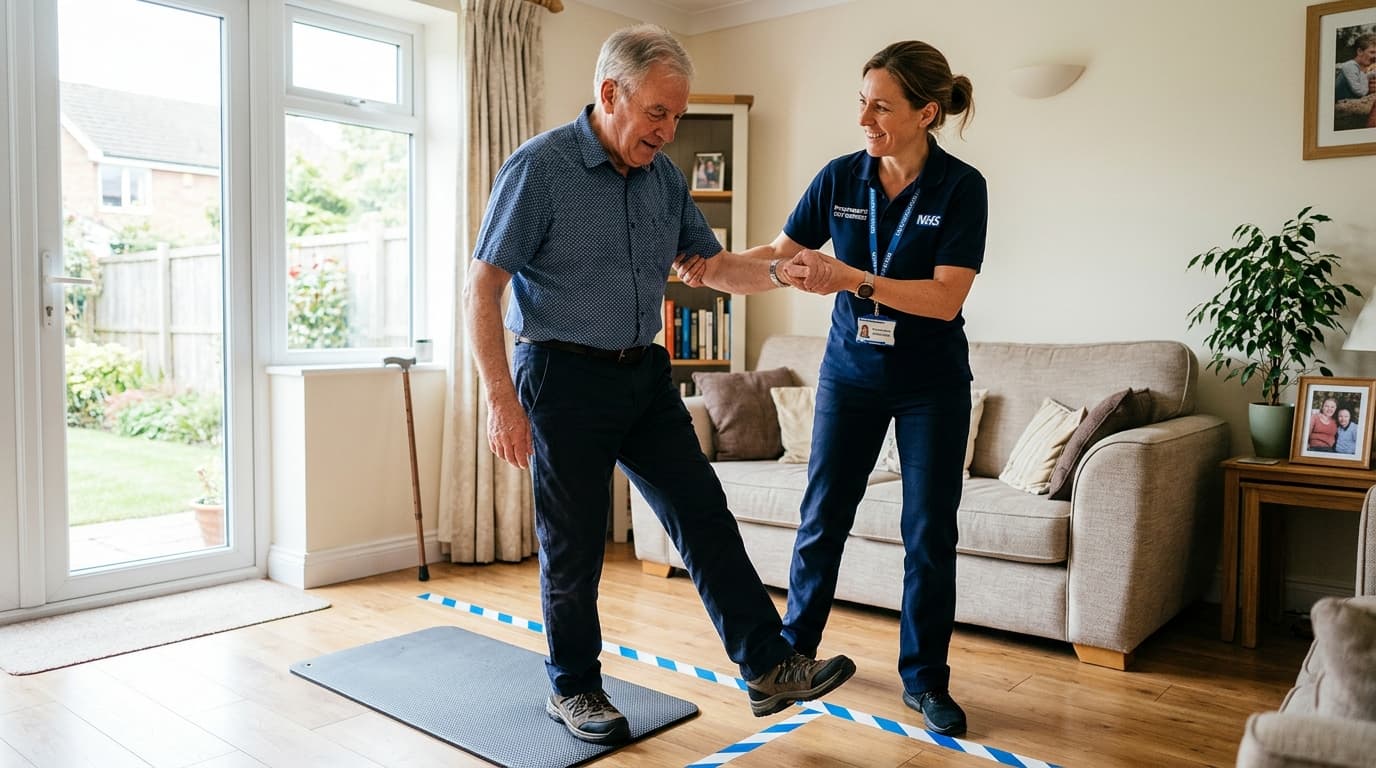
- Visual cues — stepping over a line of tape on the floor, or over the toe of a helper's shoe, often restarts movement instantly.
- Auditory cues — counting aloud ("left, right, left, right") or walking to a metronome app.
- Cognitive cues — consciously thinking "big step" rather than just trying to walk.
Families are often the ones present during a freezing episode, so learning one or two of these cues in advance — rather than instinctively pulling or steadying the person, which can worsen the freeze — makes a genuine difference in the moment. See our guide on How Family Members Can Safely Assist with Home Exercises.
Protecting Balance Before It Becomes a Falls Problem
Postural instability tends to appear later in the condition, but balance training started early has the best chance of slowing its impact. Home sessions typically include:
- Weight-shifting exercises between the feet, progressing to a narrower stance.
- Practising quick, deliberate stepping reactions to a gentle nudge (only ever with a physiotherapist or trained carer present).
- Sit-to-stand practice from a range of chair heights, since this is one of the most common places a fall risk shows up first. Explore our seated exercise guide in The Best Seated Balance Exercises for Early Recovery.
What a Home Physiotherapy Session Actually Looks Like
A typical home visit blends assessment with hands-on practice in the spaces that matter:
- Review since last visit — medication timing relative to movement quality ("on" and "off" periods), any new freezing triggers, falls or near-falls.
- Amplitude and gait work — practised in the hallway or route the person actually walks daily.
- Freezing rehearsal — identifying real trigger points in the home (a narrow doorway, a tight turn into the kitchen) and drilling the cue that resolves it, in that exact spot.
- Balance and strength — targeted to the person's current stage and any specific falls history.
- Carer coaching — a few minutes teaching a spouse or family member the cueing technique, so it's available between sessions.
How Often Should Sessions Happen?
Parkinson's is progressive, so physiotherapy works best as an ongoing relationship rather than a short course. Many people benefit from structured sessions once or twice weekly, with daily self-practice of the amplitude and gait drills in between. Because deconditioning happens quickly with reduced activity, consistency matters more than intensity. For dosing guidelines, view How Often Should a Patient Do Physiotherapy at Home?.
Frequently Asked Questions
Physiotherapy doesn't alter the underlying neurological disease process, but strong evidence shows it maintains mobility, reduces falls risk, and preserves independence for longer than medication management alone.
Light amplitude and breathing work is usually still possible, but higher-demand balance practice is safest scheduled during "on" periods when medication is providing better motor control — a physiotherapist can help map this to an individual's medication timing.
Not always, and not universally — mobility aids are introduced individually based on falls history and gait pattern, not automatically at any particular stage. --- *This article is for general information and does not replace individualised assessment. If you're managing Parkinson's and want a home mobility and falls-prevention plan tailored to your home layout, our HCPC-registered physiotherapists can help.*