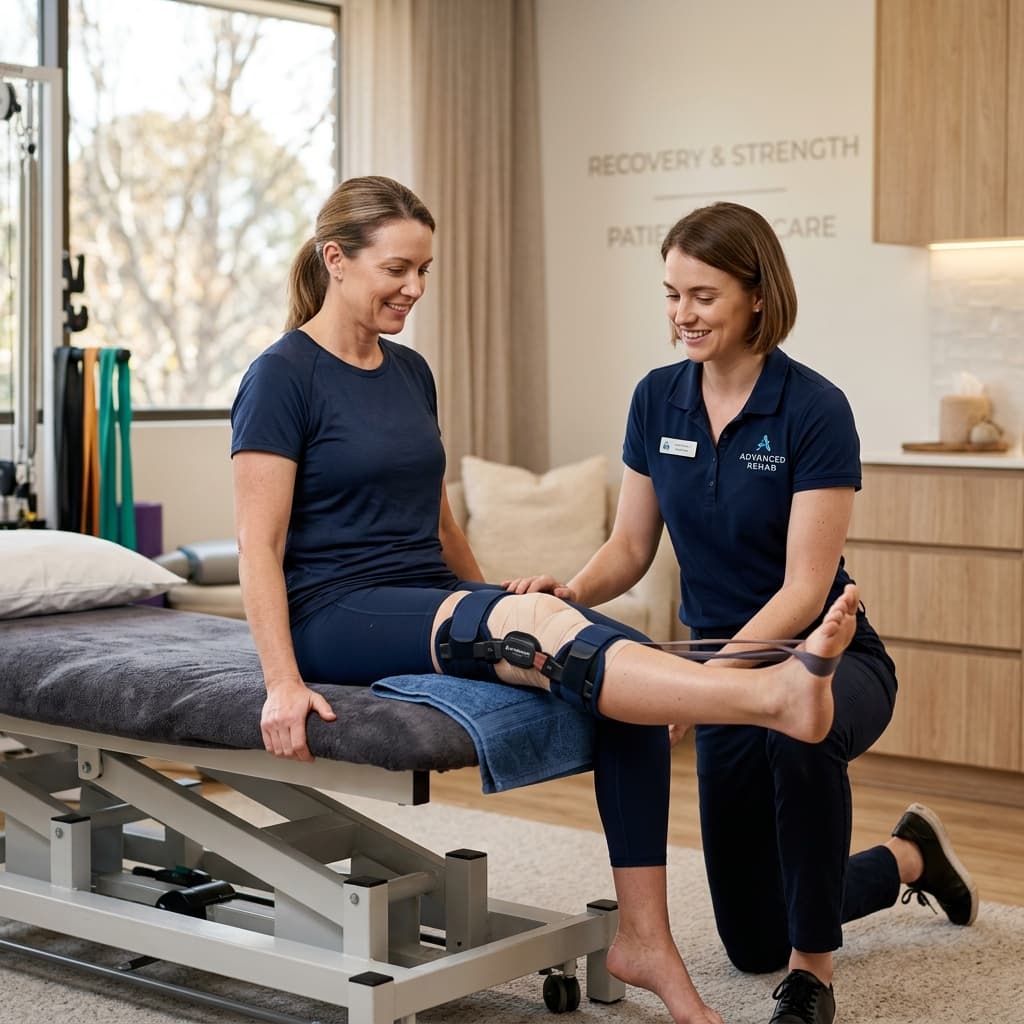
Why is my knee still stiff after a knee replacement, and what can I do? A stiff knee after knee replacement is common, and it's usually caused by swelling, pain that makes you avoid moving, tightening scar tissue, or exercises that slip down the to-do list. Settling the swelling, then bending and straightening the knee little and often through the day, is usually the best way to help it loosen.
This guide is for people roughly 4 to 12 weeks after surgery who are worried their knee won't bend or straighten as it should, and for their families. If you're in the first fortnight, our guide to the most important exercises for the first 14 days after knee replacement is the place to start. Your surgical team's and physiotherapist's advice always comes first.
Why knees get stiff after surgery
The NHS says recovery from a knee replacement can take several months, and full recovery can take up to 2 years as scar tissue heals and muscles get stronger with exercise. Knee replacement stiffness in weeks 4 to 12 is often down to a mix of these:
- Swelling. A swollen knee is a tight knee. Fluid around the joint takes up space and makes it physically harder to bend.
- Avoiding movement because of pain. It's natural to hold a sore knee still. But the less it moves, the stiffer it gets, and the stiffer it gets, the more it hurts to move.
- Scar tissue. As the knee heals, new tissue forms inside and around the joint. If the knee isn't moved regularly, this tissue can tighten and limit movement.
- Exercises not done regularly. As life gets busier and the knee feels a bit better, exercises can drop off. Stiffness can creep back in quietly.
- Muscles guarding. Tight muscles around the thigh and back of the knee can "brace" against movement, especially if you're anxious about hurting the new joint.
Your surgical team will check how far your knee bends and straightens at follow-up appointments. Some people need an earlier review if the knee isn't moving as expected. If stiffness doesn't improve, there are treatments your team may discuss. For example, the Royal Orthopaedic Hospital explains manipulation under anaesthetic, where the surgeon gently moves the knee while you're asleep. Raising stiffness early gives you the most options. If you're worried you're falling behind in other ways too, read our guide to whether your joint replacement recovery is behind schedule.
7 ways to help a stiff knee after knee replacement
1. Settle the swelling first
A puffy knee will fight every stretch you try. Bringing swelling down makes bending and straightening easier and less painful. It's often worse at the end of the day or after you've been on your feet a lot.
Try this: Before your main exercise session, lie down with your whole leg raised on pillows so your ankle is higher than your knee and your knee is straight, for about 20 minutes. Our guide to why a knee can still be swollen four weeks after surgery has more ways to manage it.
2. Little and often through the day
Short, regular sessions loosen a knee better than one long, painful one. Every time the knee sits still for hours, it stiffens up again. Moving it gently many times a day keeps the tissues used to stretching.
Try this: Link a few knee bends and straightens to things you already do, such as every time you boil the kettle, after each meal and during the TV adverts. Aim for several short sessions spread across the day, rather than saving it all for one go.
3. Heel slides with a helping hand
Heel slides are a simple way to work on bending, and by weeks 4 to 12 you can gently help them along. Using a towel or strap lets you add a little extra bend without forcing it. A slow, steady stretch is more helpful than bouncing.
Try this: Lie on your back on the bed with a towel looped around your foot. Slide your heel towards your bottom as far as is comfortable, then use the towel to gently ease it a little further. Hold for a slow count of five, then slide back out. Repeat 10 times.
4. Seated knee bends using a chair
Gravity and your own body weight can help the knee bend further. Sitting gives you lots of control, and you can ease off instantly if it's too much. It's also easy to do at home throughout the day.
Try this: Sit on a firm chair with your feet flat. Slide the foot of your operated leg back under the chair as far as is comfortable. Keep that foot planted and gently shuffle your bottom forward on the seat. This deepens the bend without moving the foot. Hold for a slow count of 10, then relax. Repeat 5 to 10 times.
5. Straightening matters as much as bending
A knee that won't straighten fully can make you limp and put strain on your hip and back. People often focus on bending and forget about straightening. Sitting with the knee bent for long periods, or resting with a pillow under the knee, can make straightening harder.
Try this: Sit with your operated leg resting on a stool or another chair, with only your heel supported, so the back of the knee hangs free. Let the knee relax towards straight for a few minutes. Then tighten your thigh muscle and press the back of your knee down 10 times. Never sleep with a pillow under the knee.
6. Use a static bike or step-ups once your team says so
Repeated, smooth movement is great for loosening a knee and building strength at the same time. A static exercise bike moves the knee through its range over and over. Step-ups help with stairs and everyday strength. Both need the go-ahead from your surgical team or physio first.
Try this: Once you're cleared, set the bike seat high enough that you can just complete a full turn of the pedals, with no resistance. Start with a few minutes. If a full turn isn't possible yet, rock the pedals back and forth. Lower the seat a little as your bend improves.
7. Time your pain relief before exercise
It's hard to bend a knee that hurts. Many people find exercise easier when their pain relief is working well. Planning your sessions around your medicines can help you get more out of them.
Try this: Ask your GP or pharmacist how best to time your prescribed pain relief around your exercise sessions. Never take more than you've been prescribed, and tell your GP if your pain is stopping you exercising.
Red flags: when to get help
Stiffness on its own is common. But some changes need checking quickly. The NHS lists complications of a knee replacement to watch for.
Contact your surgical team, GP or NHS 111 the same day if you have:
- pain, swelling, redness or warmth in your calf
- a wound that is red, hot, more swollen, oozing or leaking
- a high temperature, or you feel hot and shivery
- a sudden loss of movement in the knee, or the knee suddenly becomes much more painful or swollen
Call 999 if you have:
- leg pain and swelling with chest pain or difficulty breathing, which can be a sign of a blood clot that has moved to the lungs
- a fall with severe pain, or you can't put any weight on the leg
When to ask for help
Your surgical team
Speak to your surgical team if:
- your knee hasn't improved in how far it bends or straightens for a couple of weeks, despite regular exercises
- you're struggling to bend the knee enough to get up from a chair, climb stairs or get in and out of a car
- you can't straighten your knee and are walking with a limp
- pain is stopping you from doing your exercises
There's no need to wait for your next routine appointment if you're worried. It's much better to raise stiffness early.
Physiotherapy at home
A physiotherapist can check how far your knee bends and straightens, find out what is holding it back, and adjust your exercises so you keep making progress. If scar tightness is part of the problem, our guide to managing scar tissue pain explains how a physio can help.
Home visits can be especially useful when getting in and out of a car is still hard. At Rehalign, we offer home physiotherapy after knee replacement across the West Midlands, including Birmingham, Solihull, Walsall, Wolverhampton, Coventry, Dudley and Telford. We can work alongside your NHS or hospital team.
Frequently Asked Questions
Yes, stiffness is common for weeks or even months after a knee replacement. Swelling, pain and healing tissues all play a part. It usually improves with regular, gentle exercises done little and often. If your knee isn't improving over a couple of weeks, or you can't straighten or bend it enough for everyday tasks, contact your surgical team.
A knee may not bend well because of swelling, pain that makes you avoid moving, tightening scar tissue, or tense muscles around the joint. Exercises that aren't done regularly can also let stiffness creep in. Settling swelling and moving the knee gently many times a day can help. Your surgical team will check your progress and can review you if needed.
Settle swelling first, then move the knee little and often through the day. Heel slides with a towel, seated knee bends where you shuffle forward on the chair, and a static bike once your team agrees can all help. Don't forget to work on straightening, too. A physiotherapist can tailor these to you.
Contact your surgical team if your knee hasn't improved for a couple of weeks, you can't straighten it, or stiffness stops you doing everyday tasks. Get help the same day for a sudden loss of movement, a red or leaking wound, a high temperature, or calf pain or swelling. Call 999 for chest pain or difficulty breathing.