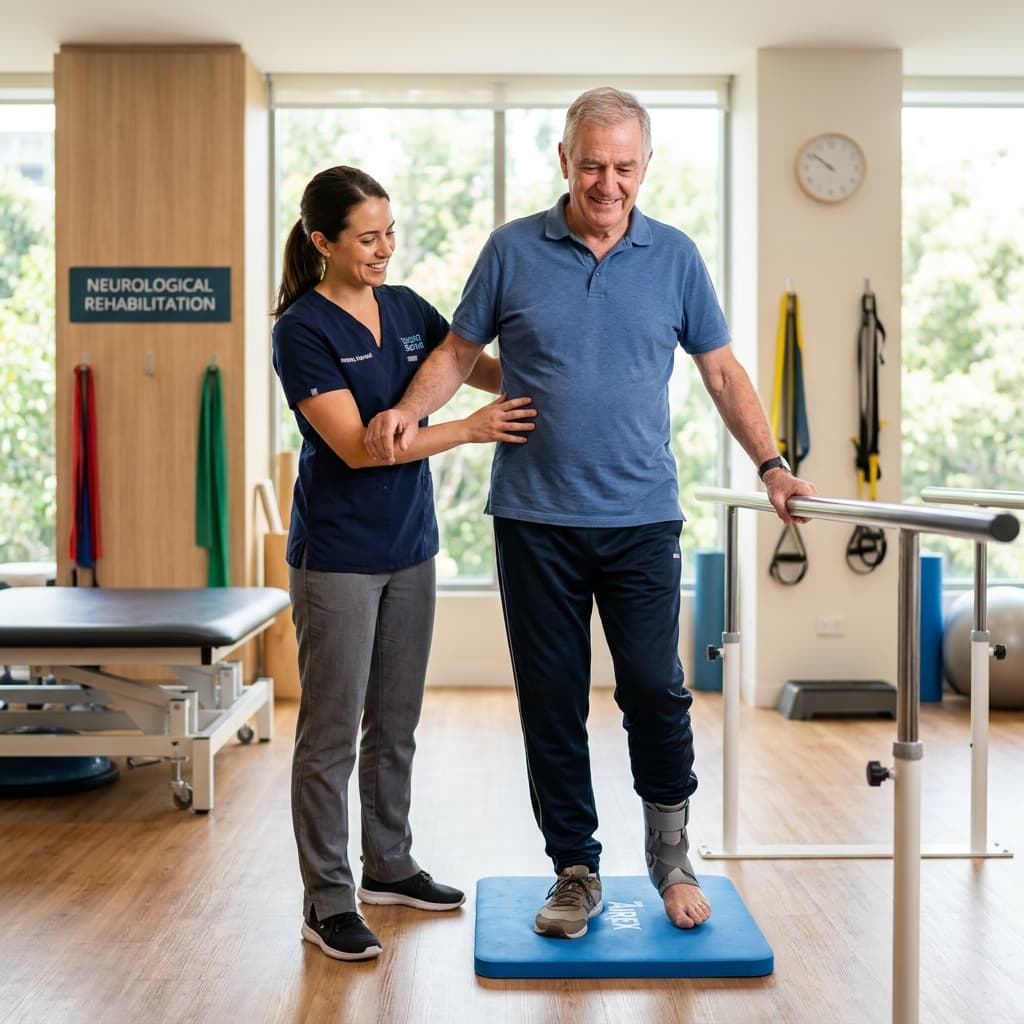
Standing balance exercises after a stroke are the natural next step once you can sit steadily and stand up with support: you practise staying upright, shifting your weight and making small movements while holding a firm surface, with someone beside you. Done slowly and safely, they help build the control you need for everyday tasks like standing at the sink and, later, walking.
These balance exercises for stroke patients at home pick up where our seated balance exercises after a stroke finish, at supervised sit-to-stand. This guide is for stroke survivors and the family members who practise with them. Check with your physiotherapist before you start, and follow their advice if it differs from anything here.
Why standing balance is the next step
Sitting balance trains your trunk. Standing asks much more: your legs, ankles and feet must work together, your base is smaller, and you have further to fall. After a stroke, one side may be weaker, slower to react or harder to feel, so standing can feel wobbly even when sitting feels secure.
The NICE guideline on stroke rehabilitation recommends physiotherapy for people whose balance difficulties affect their movement, and the NHS describes physiotherapy as a core part of stroke recovery.
Everyone's recovery is different. Improving balance after stroke can be slow and uneven, and that is normal.
Signs you may be ready (and why to check with your physio first)
You may be ready for standing balance practice if:
- you can sit on the edge of a chair or bed without leaning or tipping
- you can stand up from a chair with support and a helper, and sit back down with control
- you can stand holding a worktop for a short time without your knees buckling
- you do not feel dizzy or faint when you stand
- your physiotherapist has said standing practice is safe for you
Your physiotherapist knows things this guide cannot: how strong your weaker leg is, whether your knee locks back or gives way, how your blood pressure behaves when you stand, and whether you need a splint. If you have had a fall since your stroke, tell them before you start.
Safety set-up
- A worktop or sturdy surface. A kitchen worktop is ideal: it is a good height for most people and will not move. Never use a chair back, a wheeled frame or anything that can slide or tip.
- A helper on your weaker side. Your helper stands close, slightly behind you on your weaker side, with a hand ready near your hip. They should never pull on your weaker arm. Every exercise here needs someone nearby.
- A clear floor. Move rugs, cables and pets out of the way. Our guide to home modifications after a stroke has more ideas.
- Supportive shoes. Wear well-fitting shoes with a closed back and grippy sole, not slippers or socks. If your toes catch or your foot drags, read our guide to foot drop after a stroke and ask your physiotherapist about a splint.
- A chair behind you. Place a firm chair with arms just behind you, so you can sit down straight away if you feel tired or unsteady.
Practise when you feel most alert. Fatigue makes balance worse, so keep sessions short.
8 standing balance exercises after a stroke, in order of difficulty
Start with exercise 1. Only move on when the current one feels steady over several sessions and your physiotherapist agrees. You do not need to do all eight. Always hold the worktop and have someone beside you.
1. Standing tall with two-hand support
Standing well is the foundation for everything else. After a stroke, people often lean towards their stronger side or let their weaker knee bend or lock back. Good posture teaches both legs to share the work.
Try this: Face the worktop with both hands resting on it and your feet hip-width apart. Stand tall, as if a string is gently lifting the top of your head. Keep your knees soft, not locked, and feel your weight through both feet. Hold for as long as feels comfortable, then sit and rest. Your helper can tell you if you are leaning.
2. Side-to-side weight shift
Every step needs you to move your weight onto one leg. Many stroke survivors avoid putting weight through their weaker leg. Gentle side-to-side shifts help your body trust that leg again.
Try this: Holding the worktop with both hands, slowly slide your hips towards your weaker side, keeping your body upright. Pause, then return to the middle. Repeat towards your stronger side. Move only as far as feels safe, with your feet flat throughout.
3. Forward and back weight shift
Leaning forward and back trains the ankle muscles that make the small corrections that stop you toppling. You use this when you reach into a cupboard or open a door.
Try this: Holding the worktop, slowly shift your weight towards your toes, keeping your heels down. Pause, then shift back towards your heels, keeping your toes down. Keep it small and smooth. Your helper should stay close, as moving backwards can feel less secure.
4. Reducing hand support
Eventually you will want a hand free for tasks like brushing your teeth. Reducing how much you hold on, step by step, builds this safely. It does not mean letting go completely.
Try this: Standing tall, move from two hands on the worktop to one hand, then to a light fingertip touch. Keep your free hand just above the worktop, ready to grab it. If you wobble, hold on with both hands straight away.
5. Feet closer together
A wide stance is stable. Bringing your feet closer makes your base smaller, so your balance works a little harder.
Try this: Holding the worktop with both hands, bring your feet a little closer than hip-width. Stand tall and hold. If that feels steady over several sessions, bring them a little closer again. Do not put one foot in front of the other unless your physiotherapist has shown you how.
6. Reaching within your base
Everyday tasks involve reaching while you stand. Reaching without leaning beyond your feet trains your balance to adjust as you move. It is one of the most practical stroke rehab standing exercises.
Try this: Hold the worktop with one hand. With the other, slowly reach for a cup placed within easy reach on the worktop, then put it back. Keep your feet still and your body upright. Only reach as far as you can without your heels lifting.
7. Step forward and back
Stepping is where standing balance meets walking. Standing on one leg, even for a moment, while the other moves is a big challenge after a stroke. Our guide to walking after a stroke covers what comes next.
Try this: Holding the worktop with both hands, take a small step forward with one foot, put your weight onto it, then step back. Repeat with the other foot. Your physiotherapist will tell you which leg to start with, as each trains something different. Keep the steps small.
8. Turning the head while standing
You often look around while standing. Turning your head changes the signals your eyes and inner ear send to your brain, which challenges your balance.
Try this: Stand tall holding the worktop with both hands. Slowly turn your head to look over one shoulder, back to the middle, then to the other side. Keep your eyes open. If you feel dizzy, stop, hold on and sit down in the chair behind you.
When to stop and red flags
Stop, hold on and sit down if you:
- feel dizzy, faint or light-headed
- feel your weaker leg buckling
- feel very tired or start to shake
- have pain in your chest, hip, knee or shoulder
Rest until you feel better. If dizziness or unsteadiness keeps happening, speak to your physiotherapist or GP before carrying on. If you feel unwell and are unsure what to do, call NHS 111.
A new stroke is a medical emergency. The Stroke Association's FAST test and the NHS describe the main signs:
- Face: has the face drooped on one side?
- Arms: can they lift both arms and keep them there?
- Speech: is their speech slurred or confused?
- Time: call 999 if you see any of these signs.
Also call 999 for sudden new weakness or numbness, sudden loss of vision, sudden confusion, a sudden severe headache, or a sudden loss of balance that is not like your usual unsteadiness. Do not wait to see if it passes.
When a physio helps
A physiotherapist can check you are doing the right exercises at the right level. It is worth getting help if:
- you are not sure whether you are ready to stand
- your knee locks back or gives way
- you keep leaning to one side, or your helper finds it hard to support you
- you have had a fall or a near miss
- you have done the same exercises for weeks and want to know what comes next
At Rehalign, our neurological physiotherapists visit people at home across the West Midlands, including Birmingham, Solihull, Walsall, Wolverhampton, Coventry, Dudley and Telford. We tailor each exercise to your home and show your family how to help, alongside your NHS stroke team.
Book a stroke rehab assessment
This guide is general information, not personal medical advice. Always follow the advice of your own stroke team and physiotherapist.
Frequently Asked Questions
They can be, once your physiotherapist has said standing practice is right for you. Always hold a sturdy surface such as a kitchen worktop, keep a chair behind you and have someone standing beside you on your weaker side. Stop and sit down if you feel dizzy, tired or unsteady, and check with your physiotherapist before carrying on.
Short, regular sessions usually work better than long ones, because fatigue makes balance worse. Your physiotherapist should set the right amount for you. Choose the time of day you feel most alert and rest whenever you need to. On days you feel tired or unwell, do less or take a break, and pick up again when you feel better.
Not at first. Every exercise in this guide should be done holding a firm surface with someone nearby, ready to help if you lose your balance. Your physiotherapist may later say that some exercises are safe to do alone, depending on how steady you are. Until they do, wait for a family member or carer to be with you before you practise.
Hold the worktop with both hands and sit down in the chair behind you. Your helper can guide you down by supporting your hips, but should never pull on your weaker arm. Rest, and stop for the day if you feel shaky. Tell your physiotherapist, as they may need to adjust your exercises or check whether you need a splint or other support.