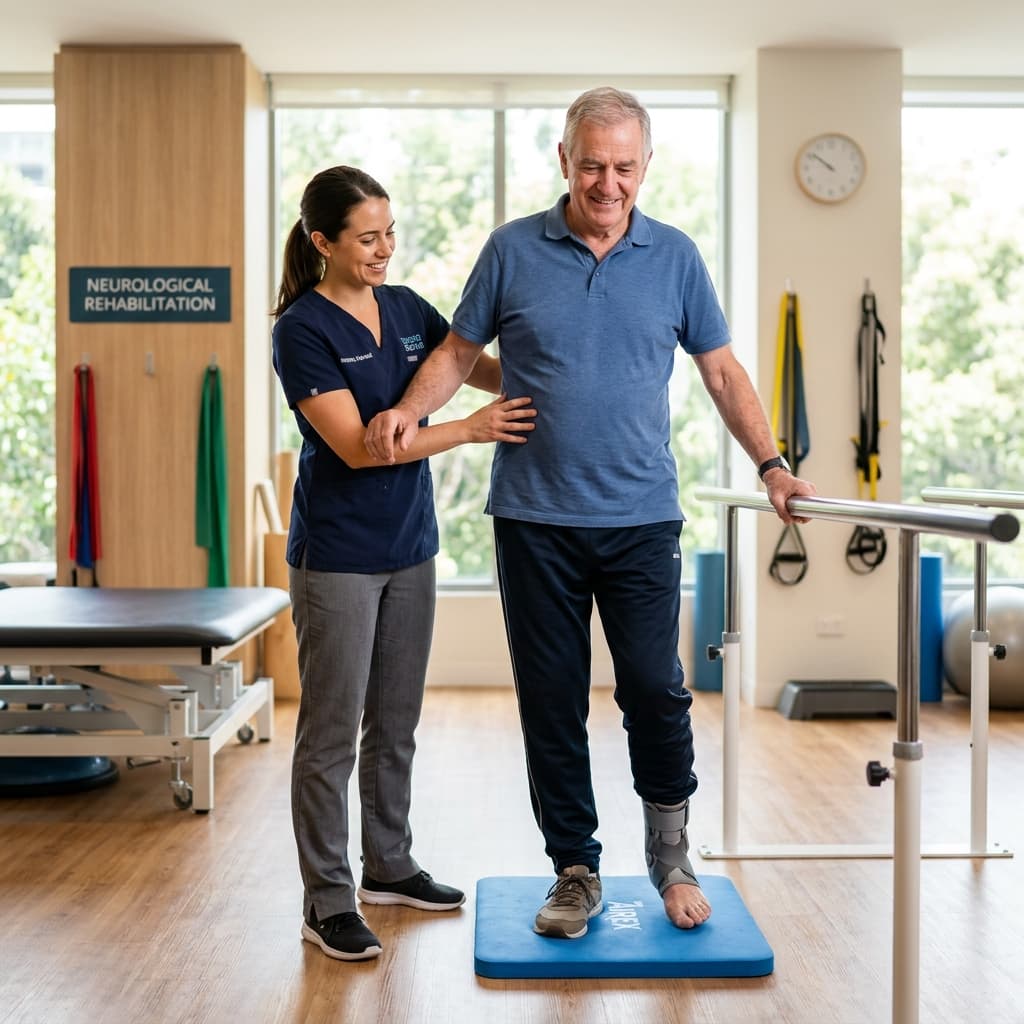
Walking after a stroke is usually rebuilt in stages: sitting balance first, then standing, then weight-shifting and stepping, then walking with support, and finally walking further and on different surfaces. Physiotherapists help by choosing the right exercises, aids and amount of support for each stage, and by getting you to practise the actual movements of walking many times. How far and how fast you progress depends on your stroke, your health and your goals, so follow your own stroke team's advice. This guide explains the stages, the tools that help and how to practise safely at home.
If you or someone you love is struggling to walk after a stroke, it is easy to feel stuck. Walking is a complex skill that needs strength, balance, feeling in the foot and leg, timing and confidence. A stroke can affect any of these, and that is why walking often needs deliberate retraining.
Why walking is affected after a stroke
Depending on where the stroke happened in the brain, you might notice:
- Weakness in the hip, knee or ankle on one side
- Foot drop, where the toes catch on the floor. See our guide to foot drop after stroke.
- Stiffness or spasticity, which can make the leg stiff or turned. Our guide on spasticity after a stroke explains this.
- Balance problems and fear of falling
- Reduced feeling or awareness of the leg and foot
- Fatigue, which makes walking tiring. Read about managing post-stroke fatigue.
- Vision or attention changes, such as missing things on one side
A physiotherapist will work out which of these matters most for you.
The usual stages of walking recovery
Everyone moves at their own pace, and stages overlap. This is a general picture, not a timetable.
| Stage | Focus | What it can look like |
|---|---|---|
| 1. Sitting balance | Trunk control, weight shifting | Sitting upright, reaching, turning. See our seated balance exercises. |
| 2. Standing | Safe sit-to-stand and standing balance | Standing with support, such as parallel bars, a frame or a helper |
| 3. Weight shift and stepping | Shifting weight onto the weaker leg, small steps | Stepping on the spot, side steps, steps forwards and back with support |
| 4. Walking with support | Walking short distances with a person, aid or rail | Using a frame, stick, rail or a therapist's help |
| 5. Walking independently | Walking safely indoors, turning, stopping and starting | Short distances, then room to room |
| 6. Community walking | Distance, speed, kerbs, slopes and busy places | Shops, uneven pavements, steps and crossing roads |
The NHS says that your rehabilitation plan depends on how much the stroke has affected you, and that exercises and therapy sessions can be hard work but help you make progress. A review of progress is also usually offered at around 6 months.
What helps people walk again
Practice, practice, practice
The brain relearns movements through repetition. Physiotherapists often use task-specific practice: instead of only doing leg exercises lying down, you practise the real actions, such as standing up, stepping, turning and walking. Our article on how long neuroplasticity takes to kick in after a stroke explains why this matters.
The right support at the right time
- Parallel bars or a rail for early standing and stepping
- Walking frames, tripods and sticks, chosen to suit your balance and strength
- A therapist or helper beside you, using safe techniques. Read our family guide on safely helping a stroke survivor with home exercises.
- Ankle-foot orthoses (AFOs) or other supports for foot drop, when recommended
- Cues, such as counting, rhythm or visual markers, to improve step length and timing
Support is gradually reduced as you improve. The aim is the least support that is still safe.
Strengthening and stretching
Specific exercises for the hips, knees and ankles help you push off, lift your foot and control your leg. Stretching helps keep muscles and joints flexible, particularly if there is stiffness.
Balance and confidence
Balance training, including standing weight shifts and gentle challenges, helps prevent falls. Confidence matters as much as strength. Fear of falling makes people stop moving, which then makes them weaker. Our article on post-fall anxiety has ideas that also apply here.
Practising safely at home
Only practise what your physiotherapist has recommended for you.
- Make the space safe. Clear rugs and clutter, use good lighting and wear supportive shoes. Our guide to home modifications after a stroke can help.
- Have someone with you until you are told it is safe to practise alone. They should stand slightly behind and to the weaker side, and never pull on the weak arm.
- Practise short and often. Several short walks usually beat one long, tiring one.
- Use the aid you have been given, every time, adjusted to the right height.
- Build up gradually. Increase time or distance only when the last step felt comfortable.
- Rest when tired. Fatigue affects balance and safety.
- Keep a log of distance, time and how you felt, to show your physiotherapist.
Common questions about the walking pattern
- Why do I drag my foot or swing my leg? Weak ankle muscles, stiffness or reduced control can cause this. A physiotherapist can find the cause and suggest exercises, cueing or an orthosis.
- Why does my knee snap back? Weak or stiff muscles can lead to the knee locking back, which strains the joint. Strengthening and cueing help.
- Why am I slow or short of breath? Walking takes more energy after a stroke, and fitness often drops. Gradual aerobic exercise helps. Ask your team what is safe for you.
- Will I need a stick forever? Not necessarily. Some people walk without an aid, some use one for longer distances or uneven ground, and some need one long term. The aim is safe, independent walking that suits your life.
When to get help
Speak to your physiotherapist or GP if walking is getting harder, you are having falls or near-falls, you have new pain, or your leg is becoming stiffer or more swollen.
⚠️ When to call for urgent help
Call 999 if you notice signs of a new stroke: face drooping, arm or leg weakness, slurred or confused speech, sudden loss of vision or a sudden severe headache. See the NHS stroke guide.
Call 999 or go to A&E after a fall if you hit your head and feel drowsy or sick, have severe pain, cannot put weight on a leg, or a limb looks the wrong shape.
Contact NHS 111 or your GP if one calf is painful, swollen, red or hot. The NHS lists these as signs of a blood clot (DVT).
Walking is more than exercise
For many people, walking is about independence: getting to the toilet, making a cup of tea, visiting a friend or going to the shops. Setting goals that matter to you, such as "walk to the end of the road" or "get to the table without help", gives your physiotherapist something real to work towards, and keeps motivation up on slow days.
Want a physiotherapist to help you rebuild your walking at home? Book a stroke rehabilitation home assessment. The cost is £90 for 60 minutes, and no GP referral is needed.
This guide is general information, not personal medical advice. Always follow the instructions from your stroke team and physiotherapist.
Frequently Asked Questions
Many people regain some or all of their walking ability, but it varies widely depending on the stroke and your overall health. Physiotherapy, regular practice and the right support give you the best chance of making progress.
There is no set time. Some people take their first steps within days or weeks, while others need many months. Recovery is often fastest early on but can continue for a long time. Your stroke team can give you a realistic picture.
Sit-to-stand practice, weight shifting, stepping, strengthening for the hips, knees and ankles, balance work and walking practice are all common. The right mix depends on your stroke, so ask your physiotherapist.
Many people use a frame, tripod or stick at first, and some move on to walking without one. A physiotherapist can recommend the right aid, set it to the right height and tell you when to change.
It can be, if the area is safe, someone is with you when advised, and you only do what your physiotherapist has recommended. Stop and rest if you feel dizzy, very tired or in pain.